Pages

Showing posts with label Malaysia. Show all posts

Thursday, November 17, 2016

Sabah State Museum: Outdoor Exhibition

At the Sabah State Museum, it wasn't just an indoor museum. were more exhibitions outside!
Walking out of the main hall, there is a small vintage car (and one motorbike) display.


They date back to the 40s


This one reminded me of the one Ron Weasley drove because of the color...


Pretty random but cool regardless display of a train


Rolls Royce. My BF said HM of Brunei still has one of these :-)

After the car display, we walked further uphill (in the scorching heat) to find the Heritage Village. There was also a hanging bridge but we didn't manage to walk on it.


There is also an Islamic Civilization Museum but we didn't walk that far :-)


Felt a little bit like we were going hiking


Quick map of the Museum exhibitions, click to enlarge
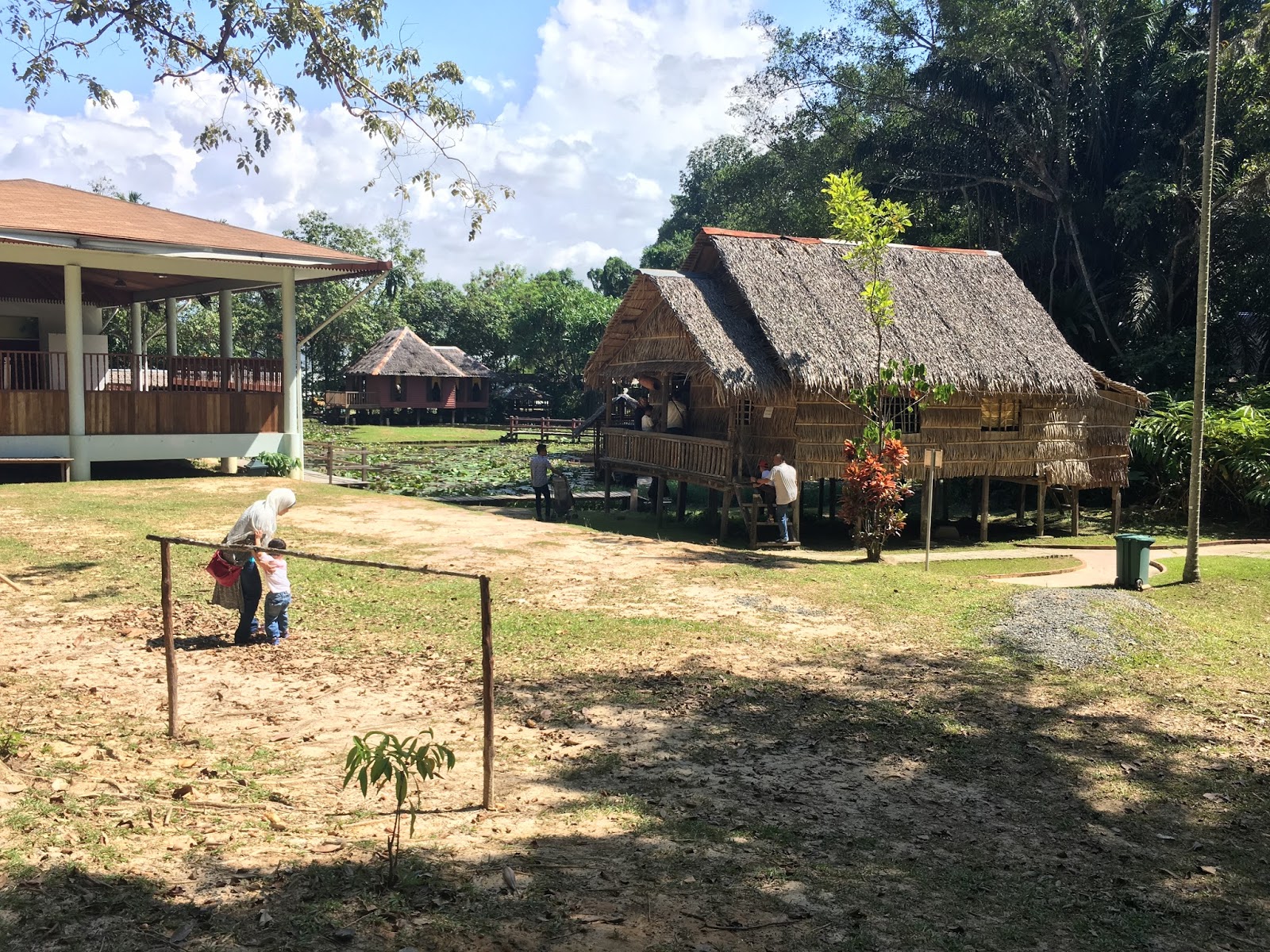
The Heritage Village was really impressive! I was given rather negative reviews about the museum about how it is not maintained and stuff, but I felt that everything, especially the Heritage Village was really well maintained.

The Heritage Village showcased the different houses the different Sabahan villages of different tribes live in all over Sabah. I've always loved my home country because we have so many different types of people that are so rich in culture and traditions of their own, and nobody is belittled or forced to behave a certain religious/ cultural way.

The walk down the Heritage Village was really interesting because each of the houses were so different yet the same, and we could enter every one of them to get closer looks.

First up was a look at the Suluk House

My BF in the Suluk House


Some of the houses had little souvenir/ trinket sellers inside

Lovely "rivers" because some villagers live on river areas. There is actually a 'perahu' under the hut that the villagers use for fishing.


Lotud House


Me in the Bisaya House

We got really excited when we saw the next house because we were not expecting it at all:


Haha, The excitement is due to me living in Brunei for decades and my BF being Bruneian.
Sabah used to be part of the Sultanate of Brunei. 
In 1658, the Sultan of Brunei ceded the northern and eastern portion of Borneo to the Sultanate of Sulu in compensation for the latter's help in settling the Brunei Civil War in the Brunei Sultanate; Northern Borneo being present day Sabah.


Something interesting I discovered that some Sabahans are Malaysians but their race is Brunei. I still have difficulty grasping that, but Brunei is not just a country but it also refers to a local ethnic group in Sabah.

After we saw the Brunei House, we saw the Hakka House which pleased me tremendously. Haha we are such geeks.

Sabahans Chinese are mostly of Hakka descent (including myself if you didn't catch the gist of why I got excited). 


I guess we were mostly farmers??

From Wikipedia, it says:
In 1882 the North Borneo Chartered Company opted to bring in Hakka labourers from Longchuan County, Guangdong. The first batch of 96 Hakkas brought to Sabah landed in Kudat on April 4, 1883 under the leadership of Luo Daifeng (Hakka: Lo Tai Fung). In the following decades Hakka immigrants settled throughout the state, with their main population centres in Kota Kinabalu (then known as Jesselton), with significant miniority in Sandakan (mainly ex-Taiping revolutionists), Tawau and Kudat. The British felt the development of North Borneo was too slow and in 1920 they decided to encourage Hakka immigration into Sabah.[42] In 1901, the total Chinese population in Sabah was 13897; by 1911, it had risen 100% to 27801.[43] Hakka immigration began to taper off during World War 2 and declined to a negligible level in the late 1940s.

 
I cannot speak Hakka to save my life (contributing to the fact that my cousin thinks I am not Sabahan) so here is a snippet of me trying (and making a fool of myself). But I can understand it pretty well as my relatives all speak it.

Kitchen in the Hakka House

We then approached a Murut Longhouse:

Yes that is a trampoline in the center, which is used for traditional games the Muruts play. It was by far the biggest (and longest, yes) house of all the other houses we entered.

That basically concluded our trip to the Sabah State Museum. We spent around 2.5 hours there and frankly it wasn't complete but it was too hot so we could not go on especially for the outdoor exhibitions.

There were a lot of Taiwanese/ Chinese tourists there visiting on tour buses.

I enjoyed the visit and it has certainly brought me closer to (half of) my roots. I am always a sucker for history (although I have trouble remembering them after a while even after intense research-- is it the age already?!). The visit definitely lingered on my mind because of the horrific insight into the World War 2 and the prisoners of war that I feel is uncalled for pure cruelty among human beings.
I definitely recommend everybody to visit the Sabah State Museum because it really is interesting and educational. Locals with MyKads pay RM 2 per entry, while foreigners pay RM15. You can use the same ticket for entrance to the Agnes Keith Museum in Sandakan  (Agnes Keith wrote the famous book "Land Below the Wind) and a few other places as well.

Monday, November 14, 2016

Sabah State Museum Day

Hello!

I was in Kota Kinabalu over the weekend for my baby nephew's 100-day celebration.

I go to KK a lot because I am half Sabahan. My bf and I were just there a month ago, so things were pretty much redundant for us. We arrived in KK on Friday evening after a quick 20-minute flight from Brunei.

We flew back on the 7:35PM flight on Sunday, so we had almost a whole day more in KK where we had nothing much else to do. We spent our Friday night and Saturday daytime in Imago mall and Suria mall for a while, so we pretty much covered whatever shopping we had to get done. So what did we decide to do?

Visit the Sabah State Museum.

For the very first time. Haha. It is quite shameful on my part because I was born in KK and am basically in KK every single year since I left at age 2. Glad my BF (100% Bruneian) agreed to wanna tag along, making my mission to bestow Sabahan knowledge onto him much easier (not that I have a lot. My cousin unabashedly said I am not Sabahan at all).

We took a Grab car from our hotel in KK Times Square and it cost us only RM8. We are now total Grab converts after many unpleasant taxi experiences, particularly in Malaysia. We took a Grabcar from Suria Mall to our hotel for RM5 while the taxi driver wanted to charge us RM20. When we insisted on RM15, he challenged us to find a taxi at that price. So off we hailed a Grabcar. Seriously, don't blame people opting for Grab car/ Uber services over yours when you guys act like such total assholes.

One of our Grab taxi drivers said that they are being harassed by taxi drivers so they have to be very cautious and careful. We were informed the same by our Uber driver in Penang back in May.

Recommendations for taking Grab Car/ Uber services:

  1. Always sit in the passenger seat in front. If you sit at the back, people will automatically know it is a Grab/ Uber service,
  2.  Try not to make the Grab/ Uber drivers wait too long because it may arouse suspicion amongst taxi drivers. These services always come with the model of the car and the plate numbers so you will be able to spot them from afar.
  3. Try to stay out of the spotlight: it will be easier to walk a bit further off from where tourists take their taxis, this again is to avoid arousing suspicion.

We've had good experiences with Grab and Uber services so far in KL, KK, Penang and Singapore. They provide a safe and cost-saving way to travel. We normally purchase airport taxi coupons at RM30 to our hotel, and we found out they only charge RM9 on Grab. They are also very convenient because you can easily plot where you are and where you want to go.

So anyway, we hailed a Grab car to go to the Museum at about 12 noon from KK Times Square. The Museum is open daily from 9AM to 5PM.

Tip: Search "Muzium Sabah" instead of the English name if you're using Grab

The Main Hall greets you when you arrive

Home tourist

There are two ticketing booths to get entrance tickets, One near the Main Hall and the other at the entrance to the Heritage Village (both on opposite ends)

 We entered the Main Hall first and we were greeted by this huge Bryde's whale skeleton display. It is 18.6 meters in length and is the biggest whale skeleton exhibit in Malaysia. It was found stranded at a beach off Gaya Island on 17th December 2006 (almost a decade ago!). Unfortunately, they failed to save the whale.

The Museum collections comprise of:

Pic taken from http://museum.sabah.gov.my/

We started off at the Ancient Culture Gallery.


 Not many photos but that section contained a lot of information about prehistoric artifacts from important archaeological sites all over Sabah. It contained plenty of tools made of stones, clays, shells, wood and bones used by the Borneo people in the past.

Also, inside this section is a very interesting (also very dark, very creepy) replica of a cave. You could enter it and look around like it is a real cave (without the smell!)

Next, we went to the Sabah History Gallery.


I found this section the most interesting of all because it details of how Malaysia came to be. Malaysia is young (only independent in 1963). 

Borneo was previously ruled by the Sultan of Brunei and Sulu Sultanate. Then came the Westerners. The British took over Sabah and coined it as North Borneo. We had our local distaste to the new ruling which resulted in local uprising against the British ruling.

The Japanese invaded Sabah during World War II (1942). The Japanese rule was a dark period for Sabah's history. From 1942 to 1045, the Japanese ruled North Borneo, along with most of the island. The locals were also against the Japanese ruling and there were several guerrilla resistance groups, such as the one led by Albert Kwok in Jesselton.
The Allied Forces sent many Australian and British soldiers in their aid and became victims to the Japanese's brutal punishment of the Sandakan Death March, where the soldiers were forced to march from Sandakan to Ranau. The March caused the death of 2,345 Allied prisoners of war through the sicknesses, diseases, hunger, thirst, whipping and shooting. 
Six survived by escaping and lived to tell the horrific experiences they suffered,
There is a War Memorial and Gardens of remembrance in Kundasang, where those who died are commemorated. I was there last December and the names of all the soldiers are listed on the wall.

There is a wall paying tribute to the figures who aided in the guerrilla movements to rebel against the Japanese and to provide refuge to the Allied soldiers by hiding them or secretly giving them food.

The Japanese surrendered in Labuan on 10th September 1945. 

North Borneo attained self-government on 31st August 1963.


One thing I didn't get was that there are so many words to read and yet the room was so dimly lit. I left with my eyes really hurting. There is a lot to read.


 This newspaper was from 1963!

 Bata wishing Malaysia longevity! How tactful.

After that, we went upstairs to the Natural History Gallery.


The Natural History Gallery section gives an overall 101 on Borneo ecology. It showed the different forests found in Borneo, such as mangrove swamps, primary and secondary forests, virgin forests and different specimens found in them. 


After that, we went to the Ceramic Gallery:


Here, we learn of the different ceramics used in Borneo, many being imported all the way from China from as early on as the Sung Dynasty through to Ming and Qing Dynasty periods.
 Jars were used for storage, wine-brewing, bride price, ritual and even burials :s
There are a lot of beautiful antique jars here, my favorite being those from the Ming and Qing dynasty periods.


Pictures here are not in order by floors. We just strolled wherever the wind took us. Here we went back downstairs to the Headhunting Gallery:


 Hundreds years ago, the fearsome headhunters roamed the land of Borneo. Armed with sword and blowpipe, they hunted human heads as trophy.

In the gallery, there are displays of swords and weapons used by Kadazandusun and Murut people to cut off people’s heads. Yep- you would not have wanted to mess with them.

head-hunting sword attached with the hair of victim


 OK--- I did not know this at the time but these skulls are apparently the real deal.
Skulls were hung up and displayed like the photo above because the headhunters believed they could ward off dark spirits and bring their families good fortune and protection.

APT expression

 Those were the many different interesting and educational sections in the Main Hall of the Museum. Will blog about the really cool Heritage Village in my next post. That section contained many different houses of different Sabahan tribes that you can enter and walk around in!